
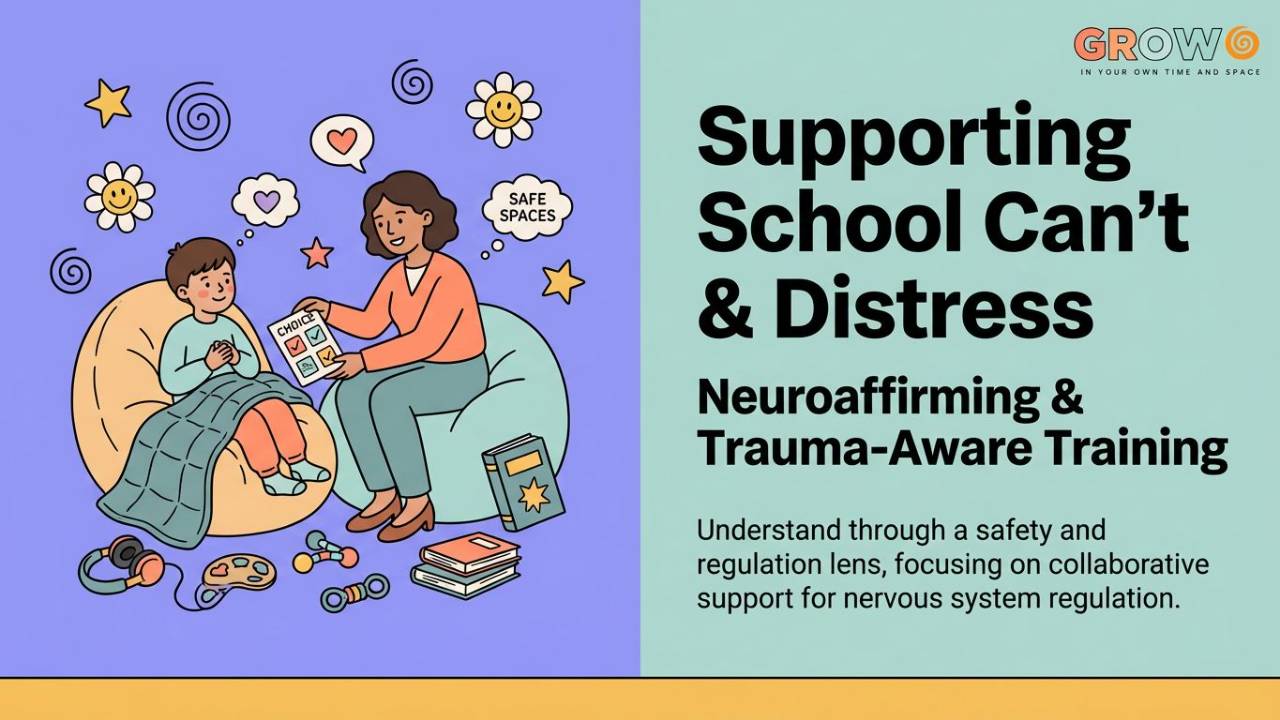
Understanding PDA, School Distress & “School Can’t”
recorded webinar
When a child or young person is struggling to attend, remain at or recover from school, the most helpful question is not:
“How do we make them go?”
It is:
“What is making school feel unsafe, overwhelming or currently impossible?”
School distress can be visible through anxiety, avoidance, shutdown, emotional distress, physical symptoms or an inability to enter or remain at school. It can also be hidden behind compliance, masking, perfectionism or appearing “fine” at school—followed by exhaustion, distress or collapse at home.
This practical two-hour webinar explores school distress, PDA and “school can’t” through a neuroaffirming, trauma-aware and whole-person lens.
We will consider how sensory load, uncertainty, social and learning demands, executive functioning, masking, autonomy, previous experiences, relationships and environmental mismatch can interact with a young person’s current capacity.
PDA and demand-related distress will be explored as an important lens, including how an intense need for autonomy may interact with anxiety, uncertainty and perceived threat. We will also recognise that not every experience of school can’t is caused by PDA and that every young person requires an individualised understanding.
Using the GROW™ Framework, participants will learn how to move beyond assumptions of refusal, defiance or non-compliance and respond with curiosity, safety, connection and practical support.
What you will learn
By the end of this training, you will be better equipped to:
-
Understand the difference between “won’t” and “can’t” when demands exceed a young person’s current capacity.
-
Understand PDA, demand avoidance and autonomy-related distress within the school context.
-
Recognise early and less visible signs of school distress, including masking, shutdown, perfectionism, somatic symptoms and distress that emerges at home.
-
Identify the sensory, relational, emotional, cognitive, communication and environmental stressors contributing to school can’t.
-
Understand how cumulative stress, burnout and previous experiences can affect attendance and participation.
-
Use low-pressure communication, meaningful choice, predictability and collaborative problem-solving.
-
Adjust expectations and environments in ways that preserve dignity, autonomy and trust.
-
Support regulation and recovery without placing the full responsibility for coping on the young person.
-
Strengthen collaboration between the young person, family, school and supporting professionals.
-
Develop flexible, capacity-aware next steps that prioritise wellbeing, connection and access to learning—not attendance as the only measure of success.
For parents and carers
You will gain:
-
Clearer language for explaining your child’s experience.
-
Greater confidence identifying patterns, stressors and unmet needs.
-
Practical ways to support mornings, recovery and communication at home.
-
Questions and prompts to use in school meetings.
-
A more collaborative framework for advocating for adjustments and flexible support.
For educators and professionals
You will gain:
-
A framework for looking beyond attendance data and visible behaviour.
-
Practical ways to recognise distress before a young person reaches crisis.
-
Strategies for adapting communication, demands, routines and environments.
-
Guidance for working collaboratively with students and families.
-
A clearer approach to developing individualised, psychologically safe and sustainable support plans.
Who is this training for?
This webinar is suitable for:
-
Parents, carers and family members.
-
Teachers, education assistants and school leaders.
-
School psychologists, counsellors and wellbeing teams.
-
Allied health and developmental professionals.
-
Behaviour support practitioners.
-
Support workers and support coordinators.
-
Anyone supporting a child or young person experiencing school distress, attendance difficulties, demand-related distress or suspected PDA.
This session provides general education and practical guidance. It does not replace individualised clinical, educational, medical or legal advice.